
For many financial institutions, lending to micro and small businesses has traditionally relied on proxies of creditworthiness rather than the realities of how businesses operate. Savings history, collateral availability, or established banking relationships often determined access to finance, leaving many viable entrepreneurs underserved.
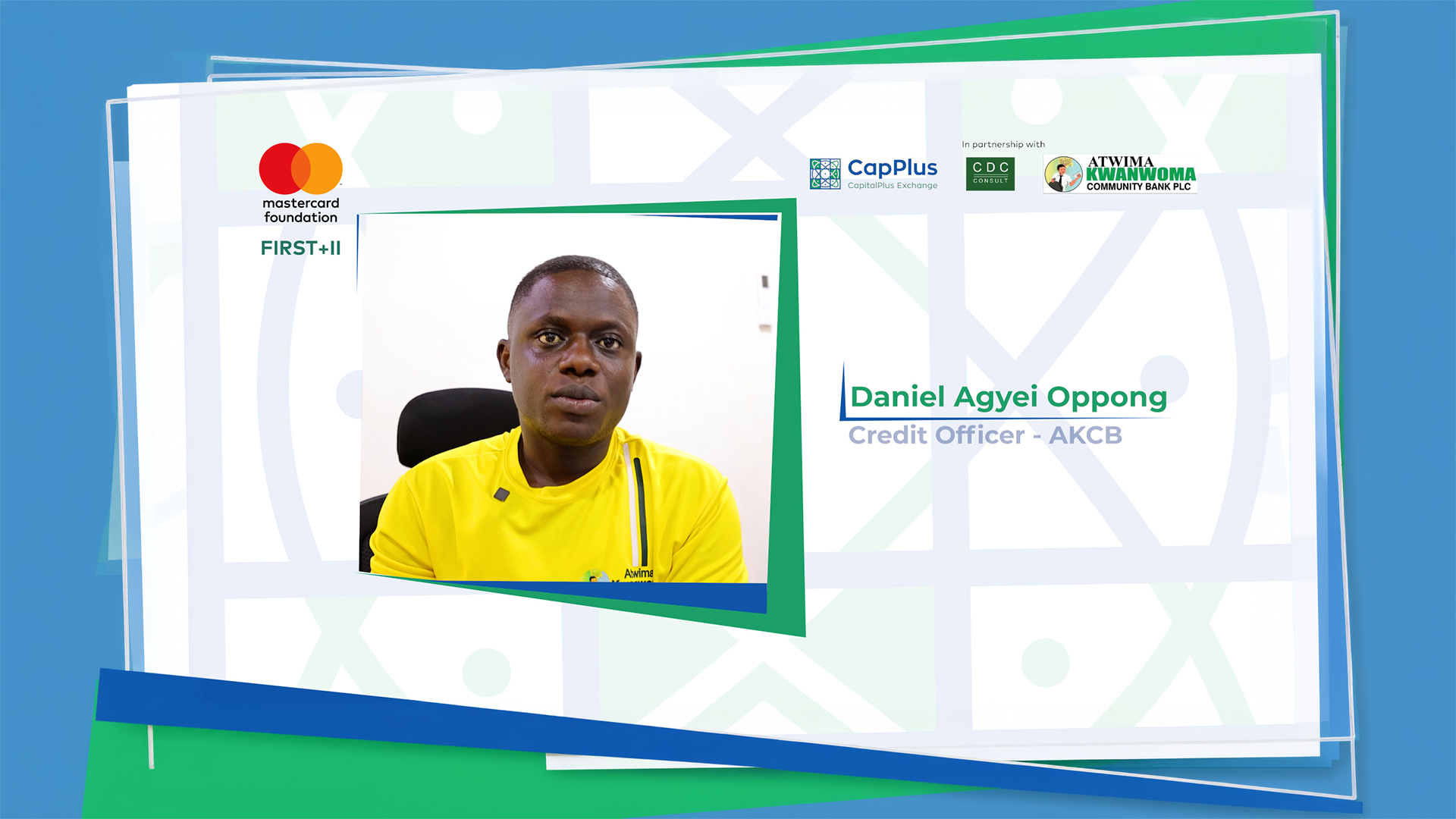
Through the FIRST+II Program, this paradigm is beginning to shift. For Daniel Agyei Oppong, a Credit Officer at AKCB, the transformation has not simply been the introduction of new lending tools; it has fundamentally changed how he understands risk, assesses businesses, and supports clients beyond loan disbursement.
Previously, loan assessments often centered on products such as susu savings, where customers were largely evaluated based on their contribution history. While useful, this approach provided only a limited picture of a business's ability to sustain and repay credit.
The capacity-building support delivered under FIRST+II introduced a more comprehensive cash-flow lending methodology, equipping credit officers to analyze how businesses generate income, manage expenses, and withstand operational risks before recommending facilities for approval.
As Daniel explains, lending decisions are now grounded in business performance rather than assumptions.
"With cash flow lending, you go beyond savings. You look at how the business operates, assess the cash flows, consider the risks, and only then make your recommendation."
This represents an important institutional shift from collateral-based lending to informed, evidence-based financing that better reflects the realities of MSMEs.
The transformation has been reinforced through practical tools introduced under the Program. Among the most impactful has been the Integrated Credit Assessment Model (iCAM), which enables credit officers to systematically evaluate customer capacity, collateral coverage, and key borrower information in a structured and consistent manner.
Complementing this is the Deposit Monitoring Tracker, a simple but highly effective tool that has changed how AKCB manages its loan portfolio after disbursement.
Rather than waiting for repayment challenges to emerge, the tracker allows officers to monitor customers' account activity daily, identify early warning signs, and engage clients before problems escalate. Instead of reactive collections, the bank is practicing proactive relationship management.
When reduced deposits are identified, officers engage customers to understand the underlying constraints and jointly develop practical solutions. For some entrepreneurs whose business schedules prevent regular branch visits, digital payment channels such as mobile money have become an alternative way to maintain account activity.
This seemingly modest operational improvement is strengthening portfolio quality while deepening customer trust.
As Daniel reflects,
"Without the deposit tracker, many of these loans would probably have gone into arrears before we noticed. Now we identify issues early and work with clients to keep them on track."
The result is a lending relationship that extends beyond credit approval to continuous business support.
The benefits of this approach are becoming increasingly visible in the experiences of MSME clients. Daniel recalls visiting Eunice, an entrepreneur who sought financing to purchase an industrial knitting machine. During the appraisal process, he understood that her business demand exceeded what a single machine could support, limiting both productivity and customer service.
Following loan disbursement, Daniel revisited the business and witnessed first-hand how the investment had expanded Eunice's production capacity and improved service delivery.
For Daniel, her experience is not unique. He observes that across his portfolio, clients are translating access to appropriately structured finance into tangible business growth.
This has reinforced confidence among credit officers that when financing decisions are informed by sound business analysis rather than narrow eligibility criteria, the quality of lending improves while enterprises are better positioned to grow.
The transformation is therefore occurring on two levels:
This alignment strengthens both institutional sustainability and enterprise development.
Daniel's experience demonstrates that strengthening financial institutions is not solely about increasing the volume of credit available to MSMEs. It is about transforming the quality of lending itself.
By equipping financial institutions with practical methodologies, decision-support tools, and client-centered monitoring systems, the FIRST+II Program is helping build a financial sector that better understands small businesses, manages risk more effectively, and expands sustainable access to finance.
Ultimately, this institutional transformation creates the conditions for stronger MSMEs, more resilient financial institutions, and greater economic opportunity for the entrepreneurs the Program seeks to serve.


