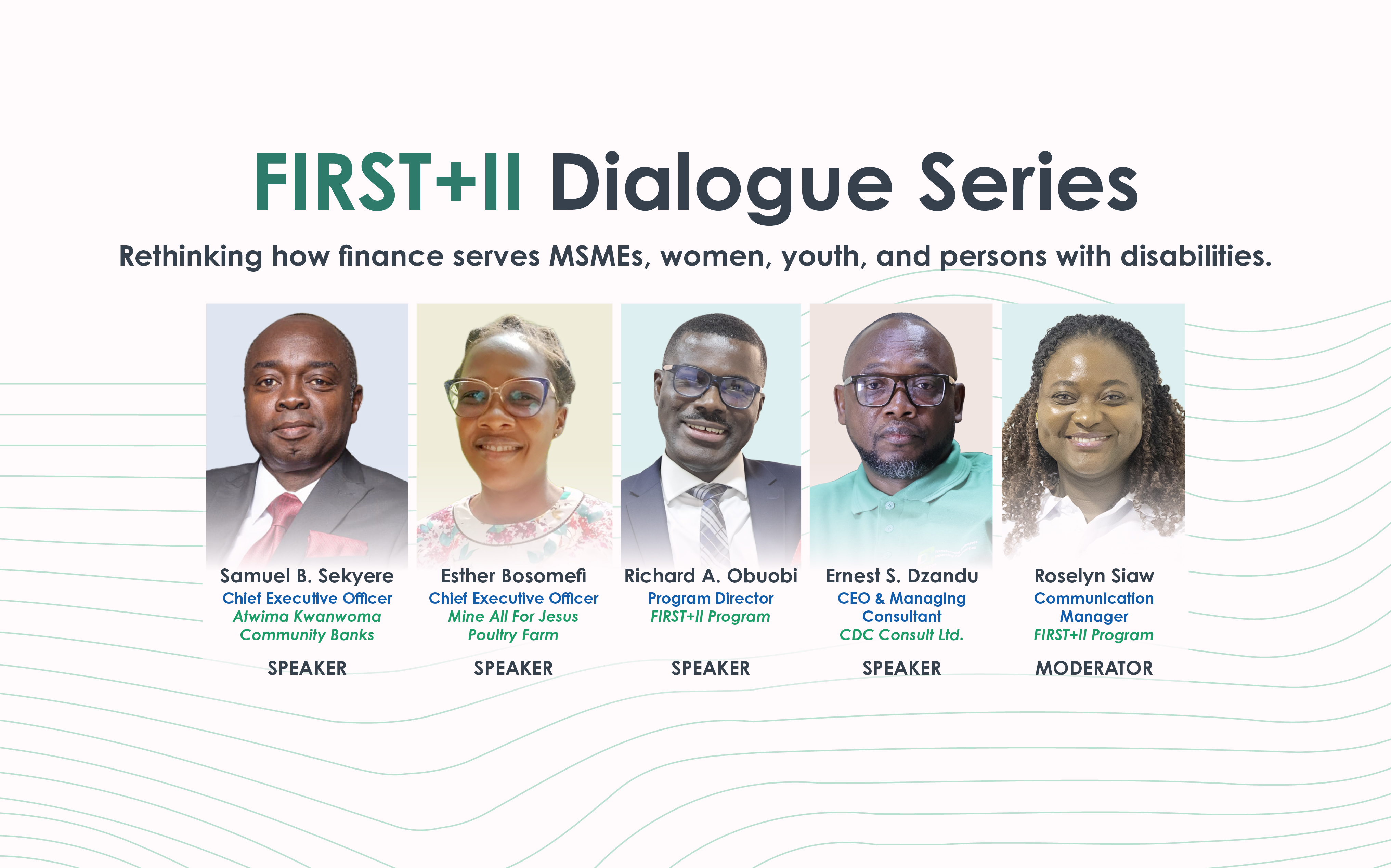
The inaugural FIRST+II Dialogue Series brought together financial institutions, development practitioners, MSME representatives, and industry leaders to examine a critical question: How can Ghana’s financial system better serve MSMEs, women, youth, and persons with disabilities?
The discussion revealed that while significant progress has been made in expanding access to finance, many underserved groups continue to face barriers that limit their ability to access and benefit from financial services. More importantly, the dialogue challenged long-held assumptions about risk, inclusion, and the role of financial institutions in supporting economic growth.
A key takeaway from the discussion was that exclusion is often not intentional but built into how financial systems are designed. Financial institutions are structured to serve individuals and businesses that are visible, documented, and easy to assess. As a result, many MSMEs, particularly those operating informally, remain outside the reach of traditional financial services despite representing a significant portion of Ghana’s economy. Panelists noted that with more than 90 percent of businesses operating informally, many entrepreneurs are excluded simply because they lack formal records, documented business histories, or the visibility required by conventional lending models.
The conversation also highlighted a critical misconception that continues to shape financial inclusion efforts: the belief that inclusive finance is primarily a social intervention rather than a business opportunity. Participants emphasized that serving women, youth, persons with disabilities, and small businesses should not be viewed as charity or concessionary lending. Instead, inclusion represents a market opportunity that can drive growth, strengthen resilience, and expand customer bases.
As Richard Obuobi, Program Director for the FIRST+II program, noted, "The demand exists. What is missing is institutional will and product design away from the traditional."
Another powerful insight was the need to rethink how risk is assessed. The discussion challenged the tendency to equate underserved groups with higher risk simply because they do not fit traditional lending criteria. Rather than relying heavily on collateral and rigid eligibility requirements, panelists advocated for approaches that focus on understanding business performance, cash flows, and customer potential. The question, they argued, is not whether risk exists, but whether institutions are using the right tools to assess it.
"We are moving beyond collateral and focusing on the strength of the business and its ability to generate cash flow." Samuel Sekyere, CEO, Atwima Kwanwoma Community Bank.
Real-world experiences shared during the dialogue reinforced this point. An MSME entrepreneur described how access to finance remains constrained not only by interest rates but also by loan tenures that do not align with business realities. For growth-oriented businesses, particularly in sectors such as agriculture, short repayment periods can limit the ability of entrepreneurs to invest, grow, and create jobs.
“Access to finance is important, but loan terms must reflect the realities of growing a business." Says Esther Bosomefi, Poultry Farmer.
Encouragingly, the discussion also showcased examples of innovation and progress. Financial institutions participating in the FIRST+II Program shared how changes in mindset and lending approaches are helping them reach previously underserved customers. One institution reported enrolling more than 700 new clients and extending over GHS 11 million in credit within six months by adopting more flexible, business-focused lending practices.
Across all contributions, a common message emerged: financial inclusion is not solely about increasing access to credit. It requires stronger collaboration between financial institutions, business development service providers, regulators, and ecosystem actors. It also demands better data, more customer-centered product design, and a willingness to see underserved populations as partners in growth rather than categories of risk.
"The financial institutions that find innovative ways to serve excluded groups are the ones most likely to unlock the next frontier of growth." Ernest Dzandu, CEO of CDC Group.
As the first edition of the Dialogue Series concluded, participants agreed that building resilient and inclusive financial systems requires more than good intentions. It requires a shift in mindset, new approaches to risk assessment, and deliberate efforts to design products and services that reflect the realities of the people they are intended to serve.
Ultimately, the conversation reinforced a simple but powerful idea: when financial systems work for those traditionally left behind, they work better for everyone.