
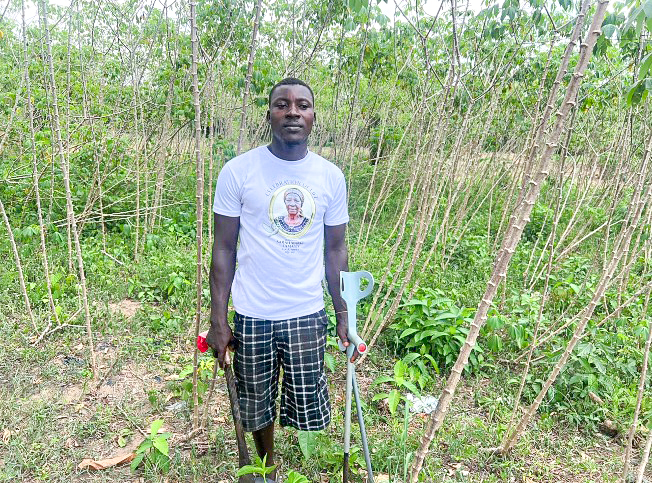
Ten years ago, Philip Atterh’s life changed in an instant. The 32-year-old skilled chainsaw mechanic and devoted father of four, Philip, had built his livelihood on hard work and craftsmanship. But a tragic motorbike accident resulted in the loss of his leg, forcing him to step away from the profession that sustained his family and into an uncertain future.
What followed, however, is a story not of loss, but of resilience and reinvention.
Determined not to let his disability define his path, Philip turned to farming. Starting with just one acre of land under a sharecropping arrangement, he faced both financial and physical limitations. Under this arrangement, 50% of every harvest goes to the landowner while Philip keeps the remaining 50%, but Philip’s resolve was unwavering.
Through perseverance and the dedicated support of his Farmer Support Agent, Deborah Quarshie, Philip has significantly transformed his farming enterprise. After participating in training on Good Agricultural Practices (GAPs), financial literacy, and banking products, as well as group dynamics, he steadily expanded his operations.
Today, Philip manages four acres of farmland, where he cultivates cassava, cocoa, plantain, and garden eggs. In addition to crop production, he has diversified his income by rearing goats and poultry, strengthening his household’s economic resilience.
Beyond his personal achievements, Philip has become a respected leader within his community. As the chairperson of a farmer group in Jumapo, he actively supports fellow farmers and promotes collaboration. Through project-supported training, he has also acquired skills in regenerative agriculture, including producing organic fertilizers from locally available materials. This has enabled him to reduce production costs while improving soil health.
Philip’s journey reflects both individual success and broader community impact.
One of the most transformative changes in Philip’s journey has been the adoption of record keeping.
“For many years, I didn’t keep records,” he reflects. “But now I understand how important it is for managing my farm and planning for the future.”
Armed with this knowledge, Philip has strengthened his ability to track expenses, measure productivity, and make informed business decisions, laying the foundation for sustainable growth.
His income is carefully managed to meet both immediate and long-term needs: supporting his children’s education, covering household expenses, and investing in the construction of a permanent family home. Access to reliable buyers for his produce further enhances his financial stability.
Equally important has been the support of his community. Rather than facing stigma, Philip is respected for his determination and leadership, an encouragement that reinforces his commitment to success.
Additionally, as his farm expands, the physical demands of managing the land alone have increased.
Looking ahead, Philip is focused on building a stronger, more secure future. His goals include completing his home, ensuring quality education for his children, acquiring his own land, and expanding his farming enterprise.
Philip’s story is a powerful example of how resilience, coupled with access to the right knowledge and support systems, can unlock opportunity. It underscores the impact of empowering farmers with practical skills, financial discipline, and community-driven solutions, enabling them to overcome adversity and build sustainable livelihoods.


