
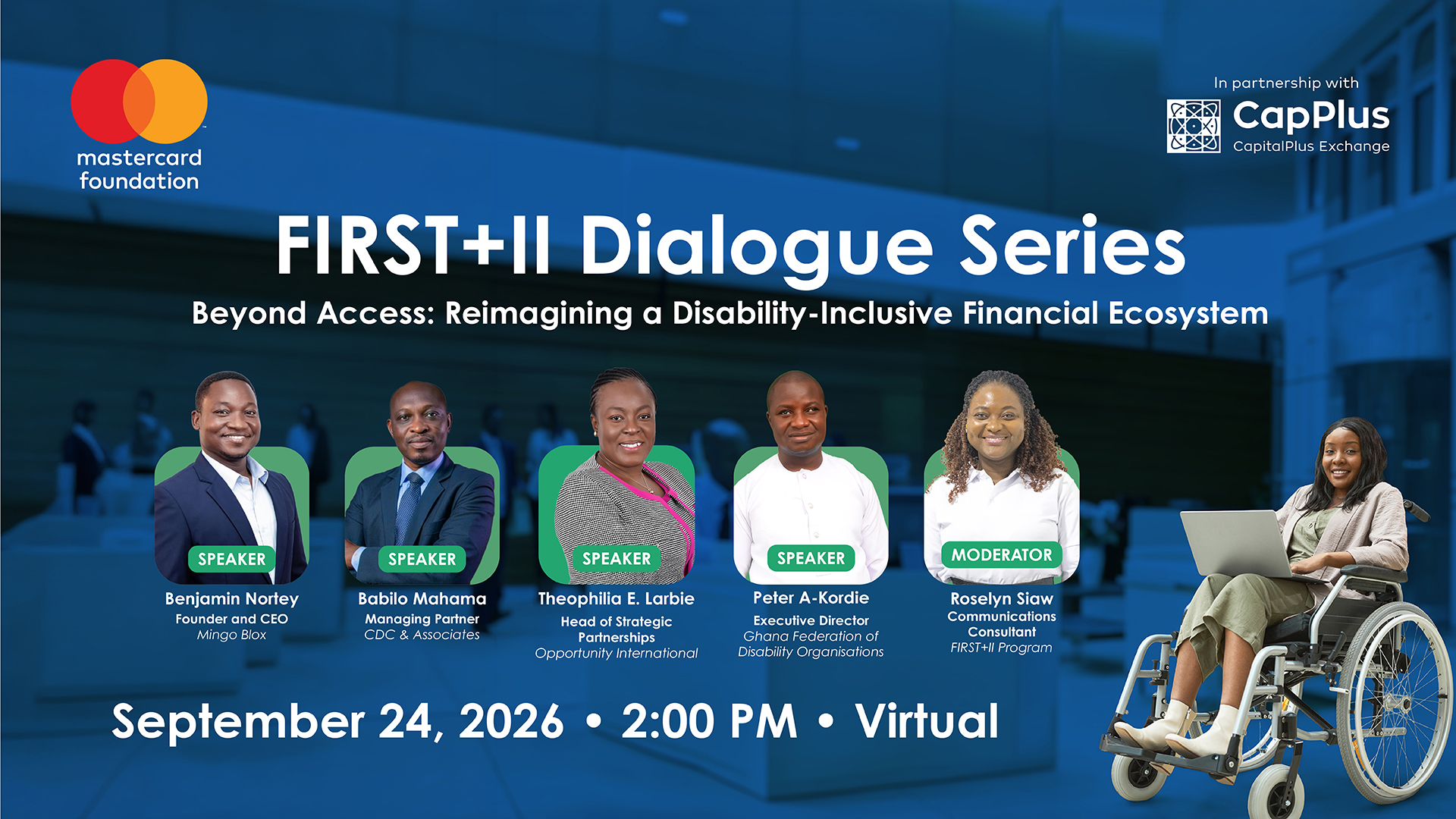
On September 24, 2026, the second edition of the FIRST+II Dialogue Series brought together perspectives from persons with disabilities, financial institutions, technology and innovation, and the wider financial ecosystem to examine a critical question: Is the financial system ready for persons with disabilities, or are persons with disabilities still being expected to adapt to systems that were not designed with them in mind?
The dialogue brought together a diverse panel of voices to examine disability inclusion from different points across the financial ecosystem. Benjamin Nortey, Founder and CEO of Mingo Blocks, brought a technology and innovation perspective; Babilo Mahama, Managing Partner, Audit & Assurance at CDC Group and consultant to CDC Consult, offered an ecosystem and institutional perspective; Peter Anomah-Kordie, Executive Director of the Ghana Federation of Disability Organizations, brought the lived experience and advocacy perspective; and Theophilia Esther Larbie, Head of Strategic Partnerships and Transformation at Opportunity International Savings and Loans, shared insights from the financial institution perspective.
The discussion moved beyond the conventional definition of financial inclusion as simply providing access to accounts, credit, or digital services. Participants emphasized that access is only the starting point. True inclusion requires that persons with disabilities can independently use financial services, benefit from them, and have a voice in how those services are designed.
Inclusion is a customer journey, not a single access point.
A ramp at a branch entrance does not necessarily make the banking experience accessible. Participants highlighted less visible barriers, including inaccessible counters, ATMs, washrooms, communication formats, digital platforms, and branch navigation. This points to the need for financial institutions to examine accessibility across the entire customer journey, rather than addressing individual barriers in isolation.
Digitalization can solve one barrier while creating another.
Digital financial services offer significant potential to reduce dependence on physical branches, but participants cautioned that digital platforms can become new barriers when accessibility is not considered at the design stage. Screen-reader compatibility, accessible websites and applications, and testing with actual users with disabilities were identified as important considerations.
The challenge is increasingly about implementation, not the absence of policy.
The discussion noted that Ghana already has relevant legal and regulatory provisions supporting disability inclusion. The more significant gap is translating these commitments into institutional systems, products, staff behavior, and measurable customer outcomes.
Data gaps are limiting the business case for inclusion.
Financial institutions highlighted difficulties in identifying and accurately tracking customers with disabilities. Without reliable data, institutions may struggle to establish targets, understand customer needs, justify investments and measure whether inclusion efforts are producing results.
One-off training is unlikely to be sufficient.
The discussion revealed that staff confidence and capability are important determinants of customer experience. However, staff turnover can quickly erode knowledge gained through disability-inclusion training. One participating institution noted that approximately 80% of staff involved in an earlier disability-focused initiative were no longer with the institution, reinforcing the need to institutionalize knowledge through onboarding, processes and continuous learning.
Strategic Implication for FIRST+II
The dialogue presents an opportunity to move disability inclusion from a standalone inclusion consideration to an institutional transformation agenda. For FIRST+II, this could mean strengthening the focus on:
• Disability-inclusive data and measurement to make customer needs and outcomes more visible;
• Accessibility-by-design in digital financial solutions;
• Continuous staff capability, rather than one-off sensitization;
• Co-design with persons with disabilities, ensuring that lived experience informs products, services and technology; and
• Outcome measurement, moving beyond the number of persons reached to whether they can independently use and benefit from financial services.
An Emerging Opportunity
A potential area for further exploration is a demonstration approach with selected financial institutions, moving from accessibility diagnosis to co-design, user testing, institutional improvements and measurement of outcomes.
Such an approach could generate practical evidence on what disability-inclusive financial services look like in practice, what changes are feasible for financial institutions, and what models can be replicated or scaled across the sector.
The next frontier may not be simply getting persons with disabilities into the financial system, but ensuring that once they enter, they can use, benefit from, participate in, and influence the system.


